
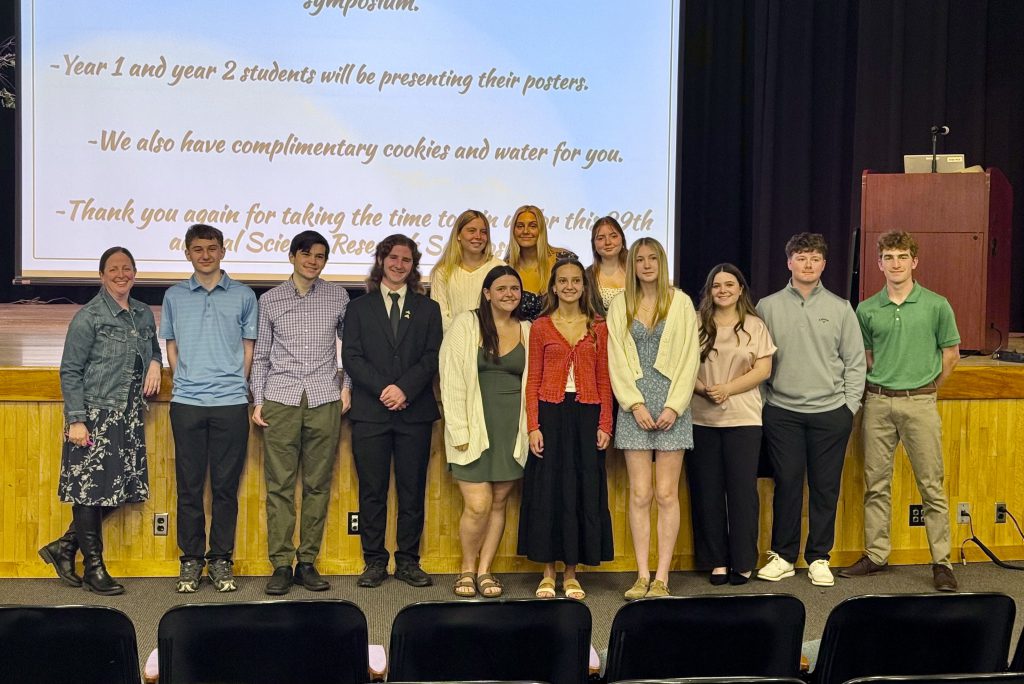
The 29th annual symposium featured a welcome from Mrs. Emily Flores, who leads the Science Research program. Lilah Crowley gave an overview of the Science Research course, followed by acknowledgements from Brayden DiSiena, who expressed appreciation for the mentors, staff, and families who support students throughout their multi-year research journeys.
Research Projects
Sophomores
- Alexandria Donato: Foraging synchrony drives resilience in human–dolphin mutualism
- Elspeth Dunbar: The Genetics of Autism Spectrum Disorders and Related Neuropsychiatric Disorders in Childhood
- Lauren Randolph: The Role of Predator Removal by Fishing on Ocean Carbon Dynamics
Juniors
- Michael Becker: The effects of sucralose on stress responses and cell wall integrity of model charophyte alga, Penium margaritaceum.
- Finn Connelly: Feeding preferences of Japanese beetle (Popillia japonica) on North American and exotic Asian Flora
- Lilah Crowley: The Impact of Geography on DNA Differences in Glioblastoma in the U.S.
- Brayden DiSiena: Occurrence and Detection of PFAS in Crops Cultivated on PFAS-Impacted Agricultural Lands
- Lara French: Analyzing Adaptive Coping Strategies People with CD That Are Associated With A Positive Quality Of Life
- Madelyn Montgomery: How Social Media Influencers Affect Teenagers’ Snacking Habits
- Gracie Sisson: Investigating the Relationships Between Trauma, PTSD, and Substance Use Among Repeat Female Offenders: A Secondary Analysis
- Parker Waldron: Sex Differences in Outcomes After Arthroscopic Glenoid Labral Repair in Athletes
Seniors
- Charles Hughes: An Analysis of Parabolic Dunes in the Waterloo, NY Area
For a full list of abstracts, click here.
About Independent Science Research at Schuylerville
The Science Research Program is a three-year, student-driven course that gives students hands-on experience with authentic scientific research. Students select a topic of interest, conduct extensive research, develop a hypothesis, work with professional scientists and mentors, carry out original research, and present their findings using the scientific method. Students enrolled in the Science Research Program have the opportunity to earn up to 12 transferable college credits through the University at Albany’s Fundamentals of Science Research course while also receiving three Regents science credits, one for each successfully completed year of the program. Throughout the course, students gain valuable hands-on experience working alongside professional scientists and researchers, developing mentorships that support their independent research projects. As a New York State-validated program recognized as a model of excellence and offered in hundreds of schools across the state, the Science Research Program prepares students for college-level research while strengthening critical thinking, communication, problem-solving, and scientific inquiry skills.
Sophomore Year:
Students explore potential research topics, review scientific literature, contact researchers and authors, and establish mentor relationships. They present journal articles and analyze the authors’ research methods and findings.
Junior Year:
Students conduct their own research projects while working closely with a mentor and regularly present their progress. College credit may be earned during this year.
Senior Year:
Students complete their research, write a formal research paper, and enter regional, state, and national science competitions. Research may also be published and college credit may be earned during this year.